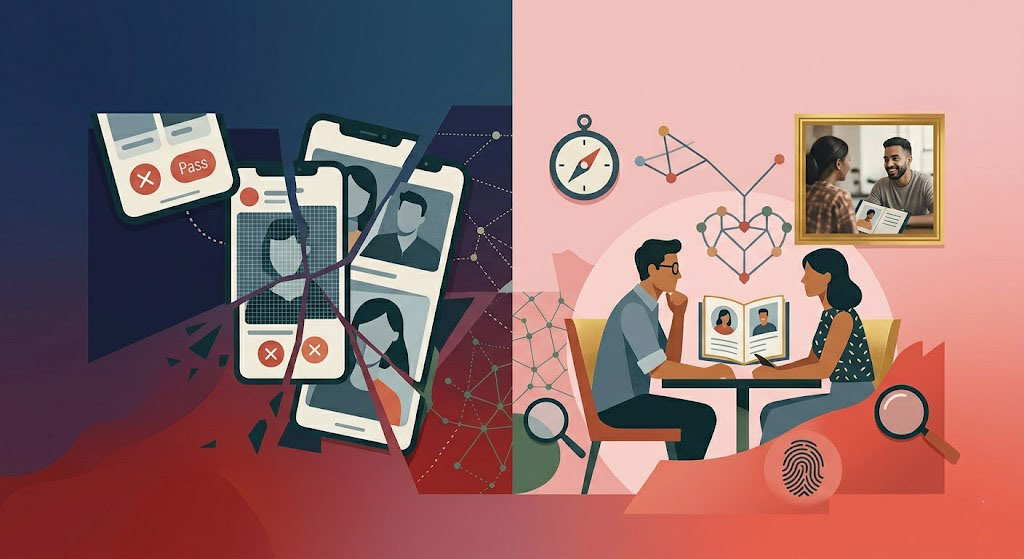

“The business of finding the one is expanding at the intersection of culture, identity and fatigue-led quitting behaviours — from swipe-led strategies to matchmaking India’s most eligible singles”, writes Usha Kumari.
The most eligible singles are tired of hearing ‘Let’s see where it goes,’ and they are making a choice to navigate their own journey of finding a partner. India is a young country, which also means it has the highest population of marriageable youth. In the mid-2010s, the country’s youth found the autonomy to choose their prospects in a more liberal setting — dating apps. After a decade, however, a declining interest in dating apps for finding companionship is becoming increasingly evident. The reasons are varied.

A week ago, I was at the salon for a regular visit when I overheard two ladies talking about how one of their daughters had found her groom through a modern matchmaking company, which is apparently new. As happy as she was, she also shared the challenges her daughter had gone through over two years. It was nothing other than dating fatigue, and it is more real than ever. Millennials and Gen Z are shifting from dating apps to modern matchmaking platforms.
The swipe-based approach to finding Mr. Right or Miss Right is undergoing a notable transformation. Millennials are overwhelmed by the abundance of photo-based profiles. These platform users lack sincerity, commitment and clarity. Swiping comes with deep uncertainty, and that uncertainty represents a business opportunity in a growing market projected at a 9–10% CAGR. Renowned dating apps are reporting a decline in users. One well-known swipe-based dating app reported a 7% year-on-year drop in monthly paid users in Q3 2025.
Initially, global dating apps were focused on penetrating the Indian market across cities. Now, these apps are struggling to position themselves as sincere and genuine platforms amid rising frauds and scams. Meanwhile, a relatively serious dating app has been signalling steady growth over the past two years. There was a sudden moment of marketing when the current Mayor of New York City, Zohran Mamdani, candidly mentioned the platform in finding his wife. The dating profiles were filled with mentions of finding his better half. Millennials found it relevant as it was a contemporary remark on finding a compatible partner. The company cited a 17% growth in paid users, signalling that intentional matchmaking is very much the need of the hour.

This behavioural shift is an aftermath of the dating era, where situationships, benching and cushioning are the norm — the jargon that is common within the dating pool. It poses a challenge for the marriageable generation, given the role of cultures, customs and the limitations of finding a partner within their communities. It is a conjuncture point where the success rate of dating is relatively skimmed. Many young Indians are letting go of their romantic relationships due to the pressures of society, culture and structure. Social acceptance still plays a considerable role. A generation that grew up on the aspirational love stories of Bollywood is now facing the realities of love’s tragedies. Gen Z is learning from it and joining millennials in migrating from dating apps to matchmaking platforms.
Cultural sensitivity, security and privacy are enabling this market to grow faster. Increasing divorce rates and the challenges of remarrying are two other strong drivers providing matchmaking companies with the opportunity to expand. The marriage mindset is emotional, and users do not want to become victims of missed timelines and hurriedness. Shared values and traditions still play a vital role, despite the renegotiated structure of compatibility. Increased migration, independent living and the agency to build a life together are key factors driving this industry. Matchmaking companies are monetising this opportunity by providing secure, stable and sincere services. It is an amalgamation of traditional matchmaking and the liberal choice of choosing who you want to spend your life with.
Marriage as an institution plays an integral role in social structure. Having social norms while demanding independent living is driving this market. Among established and well-positioned dating app companies, there are new entrants carving out their niches. Homegrown matchmaking platforms are experimenting to cater to their target audiences, while many traditional matchmakers are joining this movement by offering their services digitally. As matchmaking companies gradually capture this market, millennials and marriageable Gen Z are sincerely considering this as a path to building a secure future.
About the author:
Usha is a brand marketing professional and communication expert. She has worked with Aditya Birla Fashion & Retail and CaratLane, and consults brands on content and brand marketing. She serves as Visiting Faculty at the National Institute of Fashion Technology.